This guide is for the operator, not the designer. It covers theme park lantern festival planning from the first decision to the second season: choosing a format, route planning and guest flow, the season window, staffing the night, ticketing, and the supplier brief. It also covers theme park lantern festival operations, the part that decides whether season two is easier than season one.
Why a lantern festival, and when it is the wrong answer
For a park with unused evening footfall, a lantern route adds a second experience without touching the rides. Guests who have finished the attractions stay longer, and guests who do not ride get a reason to come. The commercial case for night programming is settled, so this guide works through what running one takes.
It is the wrong answer in three cases. No evening operating pattern, because building one is a larger project than the lanterns. No secure, controllable route, because fencing, staffing and egress planning come first. And a season that already peaks, because the format earns its keep in the shoulder periods.
Choosing the format before the design
Three formats cover most briefs, and they are not interchangeable.
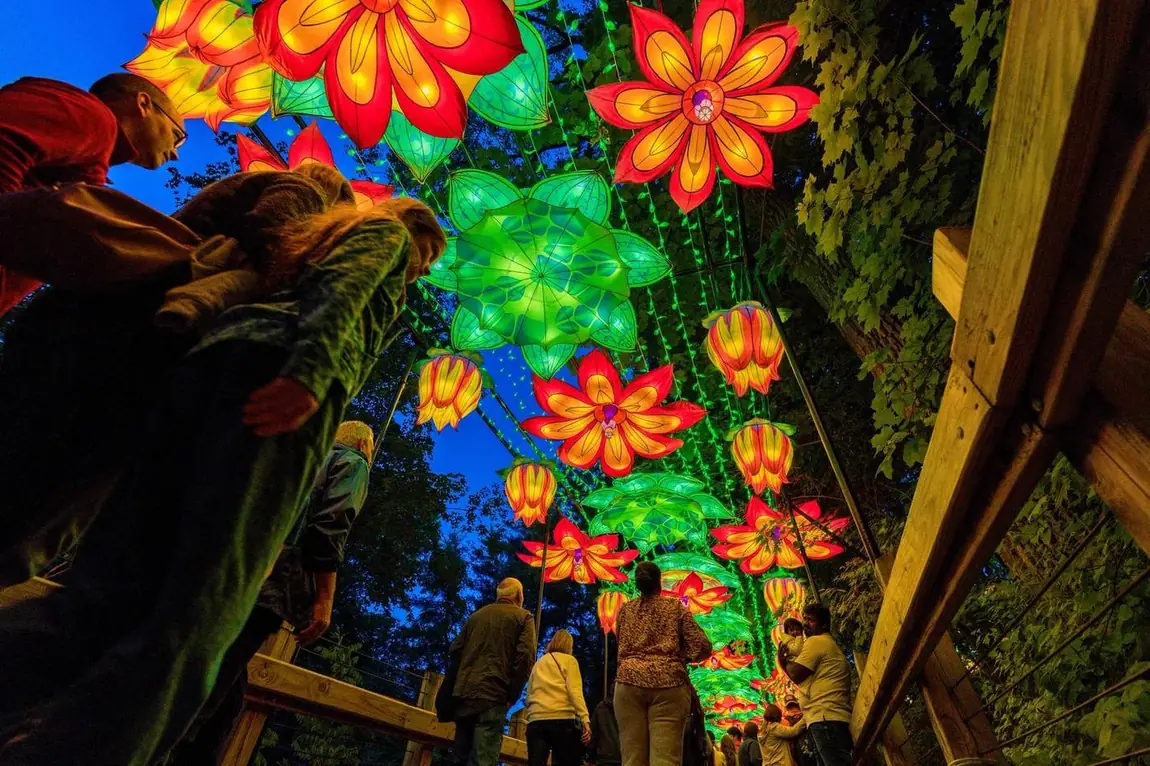
A walk-through trail is a routed sequence of scenes with a defined entry and exit: longest dwell, most control over flow, most staffing.
A static display cluster concentrates the work in one plaza or courtyard. Cheaper to run and easier to supervise, and guests treat it as a stop rather than an experience.
A single hero piece is one large, photographable installation. Lowest operating cost, and the weakest case for a separate ticket, because there is only one thing to see.
The choice follows what you want the ticket to mean. A trail justifies timed entry and a price. A cluster supports a programme you already run. A hero piece is a marketing asset that happens to be physical.
Route design: the operational core
This is where the event is won or lost, and it is the part most often left to a designer rather than an operator.
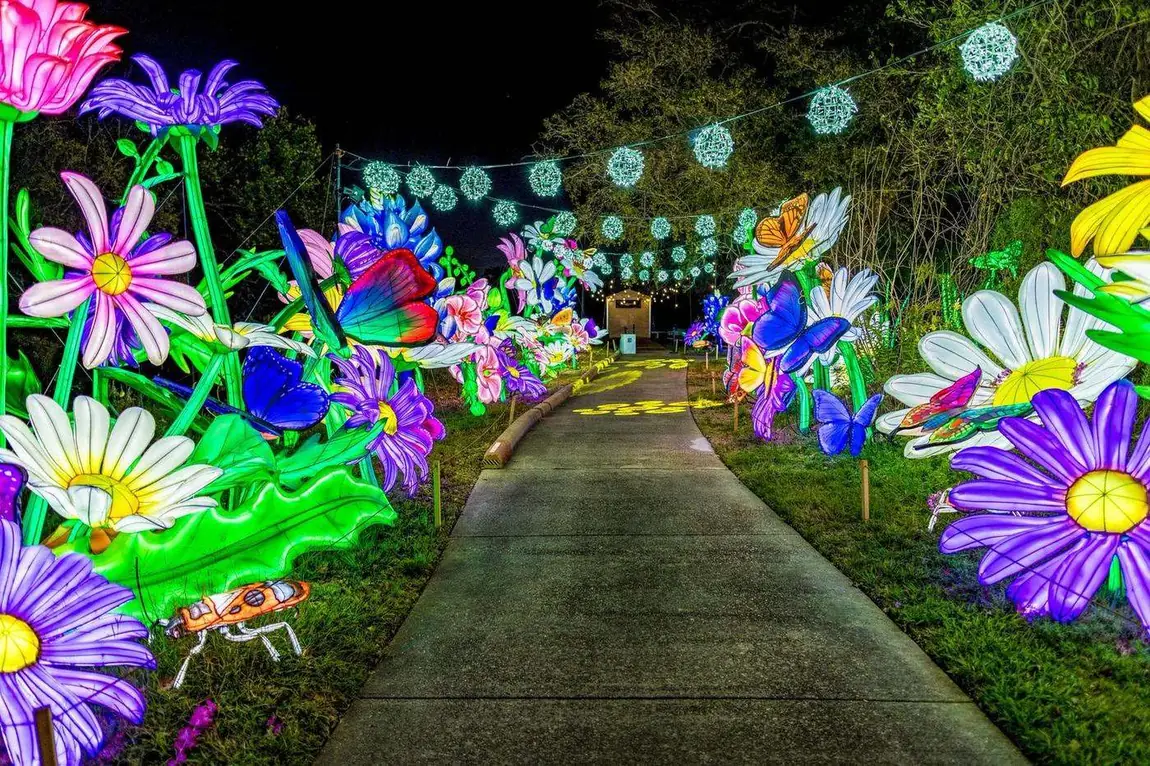
Lay the route as a one-way loop wherever the site allows. Two-way flow on a narrow path creates the point where guests stop moving, and it is usually the first thing to break on a busy night.
Then place stops deliberately. Guests do not walk at a constant speed: they walk, stop, look, photograph, and walk again. Every scene you want noticed is somewhere they will stand, so the width there has to hold a group standing still plus everyone passing behind them. A scene on a narrow section blocks the route; the same scene at a widening or a junction costs nothing extra.
Plan the transitions as carefully as the scenes: they are a natural place to slow guests without a queue forming.
Where a site is new to this, the planning approach behind our theme park lanterns work shows how routing and themed zones are reconciled with infrastructure that already exists.
How many guests an hour a night route can carry
Treat this as a calculation for your own site, not a number anyone can hand you. Throughput on a walking route is set by the slowest segment, not the average.
Four inputs. The narrowest point on the route, which you measure, because every other figure is optimistic against it. The spacing you are prepared to allow. The dwell time at each stop, estimated as a range and planned for the upper end. And the length of the walk, since a longer route holds more people at once, but only if the stops are spread along it.
A purely hypothetical example shows the shape. A 600 metre one-way route with six stops, spacing that lets roughly 40 guests be on it at once, and 25 minutes average time on route implies about 90 to 100 guests entering per hour. Change the dwell at two stops and the number moves. Knowing that limit is what stops you overselling a four hour evening.
Picking the season and the date window
Operators tend to start with the theme. It is more useful to start with the window.
Four constraints decide it. Daylight, because a route reads from dusk, so a midsummer event at a northern latitude starts late and ends early. Weather, because a build comfortable in autumn may be wrong for a coastal winter. The park's calendar, because the event needs dates where it does not compete with peak operation for staff and parking. And the local events calendar, because a rival festival in the same city, in the same weeks, splits the same audience.
The window also fixes the ordering deadline, which is not negotiable the way a design is. Lantern work is a handcraft pipeline with a finite number of build slots, and the season does not move. The order timeline for a winter opening is set out in our guide to planning a Christmas light trail.
One note rarely seen in planning documents: attendance can vary significantly across a multi-week run, so staffing should not assume an even nightly pattern. Use advance sales, local calendars and early operating data to adjust the rota as the event progresses.
Ticketing: a separate ticket or included in admission
This changes what the event is, so decide early.
A separate ticket gives a clean revenue line, a measurable attendance figure and a natural way to control flow through timed entry. It also adds friction, because guests have to understand why the thing they came for costs extra, and the event then needs its own marketing to fill.
Including it in admission removes that friction and lifts the value of the park ticket, which matters if your problem is daytime conversion rather than evening revenue. The trade-off is measurement: you never learn what the event earned on its own.
A third option is to include it for the first season, then move to a separate ticket once an audience exists. Plan the transition, because a price appearing in season two is a different conversation with the same guests.
The budget lines that are not the lanterns
The build cost is the visible part of the budget and usually the most carefully quoted. The lines that decide whether the event makes money sit around it: staffing for the full run of nights, not just the opening weekend; power and infrastructure; marketing, a real budget for a first-season event rather than a social post; ticketing and entry systems if the event sells separately; security and medical cover, sized to the crowd your throughput calculation produces; and contingency, because outdoor events lose nights.
What the lanterns themselves cost is covered in our guide to what custom lanterns cost. The point is that a build quote and an event budget are different documents, and approving the first without the second is how a night event becomes a loss.
Staffing and running the event night by night
An evening event needs a rota that survives week three, not one that works on opening night.
The roles that matter are route marshals at the pinch points and transitions, entry and ticketing staff, a technical contact who can resolve a lighting fault during operation, cleaning, and whatever food and beverage the route supports. Marshals convert a route design into real flow, so their positions should come from the plan, not from wherever people stood on the first night.
Two things go wrong in week one with some regularity. A stop turns out to be a bottleneck once real guests behave differently from the model, which is a positioning fix rather than a redesign. Or a fault on one scene is treated as small, when it removes the reason guests walked that far. Both are cheaper to solve when the operating team can decide on site, which is one reason a supplier who stays involved past installation is worth more than one who does not. How that handover works is set out in our turnkey lantern festival service overview.
Weather, contingency and public safety
Every outdoor night event needs a written answer to one question: what happens on a night you cannot open? The plan covers the decision threshold, who makes the call, how guests are told, and how tickets are moved. It should exist before the first night.
The physical considerations are familiar to anyone who has run an outdoor attraction: drainage along the route, wind exposure at the site itself, clear widths for emergency access, and egress that works when the route is full.
Where a route uses pieces that move, the safety case gets more attention, because a moving element beside a public path needs a defined clearance and a defined failure mode. Motion should be a deliberate choice for specific scenes, and our animatronic pieces explain how movement is combined with lantern construction when a scene genuinely needs it.
What to measure, and what success should mean
Judge the event on numbers that describe the guest experience and the commercial effect, not the ones easiest to collect.
Worth tracking: entry volume per night and per slot, time on route, food and beverage attach rate, the share of guests who came specifically for the event, return visits within the season, and how many photographs guests post unprompted. That last one is next season's marketing, measured early.
Worth avoiding: comparing a rained-off Tuesday to a clear Saturday, and judging the event on its opening weekend. A single night tells you about the weather; a single weekend about novelty.
The useful benchmark is the event's own second half against its first. If attendance and dwell hold up after the initial curiosity has passed, the format is working. Our project record shows how different venues have approached this.
Working with a supplier: the questions that decide the outcome
The quality of the answer you get is set by the quality of the brief you send.
Send the park plan with the proposed route marked, photographs of the ground at the points you are considering, operating hours and season dates, where power is available, the access route a delivery vehicle can take, and the guest numbers you are planning for. A supplier who receives that can give a specific answer; one who receives a theme and a budget cannot.
Then ask what separates a manufacturer from a reseller. Who engineers the steel structure, what design documentation is supplied, and which approvals must be completed locally? Who is responsible for the electrical design and local sign-off? What happens if a piece fails mid-season? Those answers matter more than the showreel.
Planning the second season before the first one ends
The decision about year two should be made while the pieces are being designed, not after the event closes, when everything is packed.
Some displays can be stored, reinstalled, reconfigured or repainted. Some cannot, and the difference usually sits in the design and materials rather than the theme. How long a display lasts, and how storage is done properly, is covered in our guide to lantern display lifespan.
Settle two questions at brief stage: which pieces are intended to return, and what the storage and refresh arrangement will be. Reusing selected pieces in a second season can improve the commercial case when storage, refurbishment and reinstallation are planned from the start.
Questions operators ask before committing
How far ahead should a park start planning a lantern festival?
The design work can start any time, but the build calendar is the real constraint. Lantern production is a handcraft pipeline with a finite number of slots per season, and dates near Christmas and Chinese New Year fill first. A winter opening is safer if the brief is agreed in the first half of the year.
Should a night event be a separate ticket or included in park admission?
Separate if you need a revenue line and a measurable attendance figure. Included if your problem is daytime conversion and you want to lift the value of the existing ticket. The trade-off is measurement, because an included event never tells you what it earned.
How do you work out how many guests a lantern route can handle per hour?
Divide the route into its slowest segment rather than averaging across the whole walk. Measure the narrowest width, decide the spacing you will allow, estimate dwell at each stop and plan for the upper end, then test that against the walk length. The result is a guests-per-hour figure, and a timed-entry slot is that figure multiplied by the slot length.
What happens to a night event when the weather turns bad?
Nothing good happens by default, which is why the answer belongs in writing before opening night. A closed-night plan should name the decision threshold, who makes the call, how guests are told and how tickets are moved. The physical side is the familiar outdoor set: drainage, wind exposure at the site itself, and clear widths for emergency access.
What does a park need to send us to get an accurate answer on scope?
A marked park plan, ground photographs at the points under consideration, operating hours and season dates, power locations, the delivery access route and the guest numbers being planned for. Those inputs are the difference between a specific answer and a generic one.
Can the same build be run for more than one season?
Often, but it is a design decision rather than an assumption. Some displays can be stored, reinstalled or repainted; some cannot, and the difference usually sits in the design and materials rather than the theme. Settle which pieces return, and the storage arrangement, at brief stage.
If you are weighing up a night event for a park, send us the park plan, the proposed route and the season you are considering, and we will tell you what the event needs and where the constraints are likely to sit. Send us your park plan and we will work through it with you.