A beast at the centre of the night
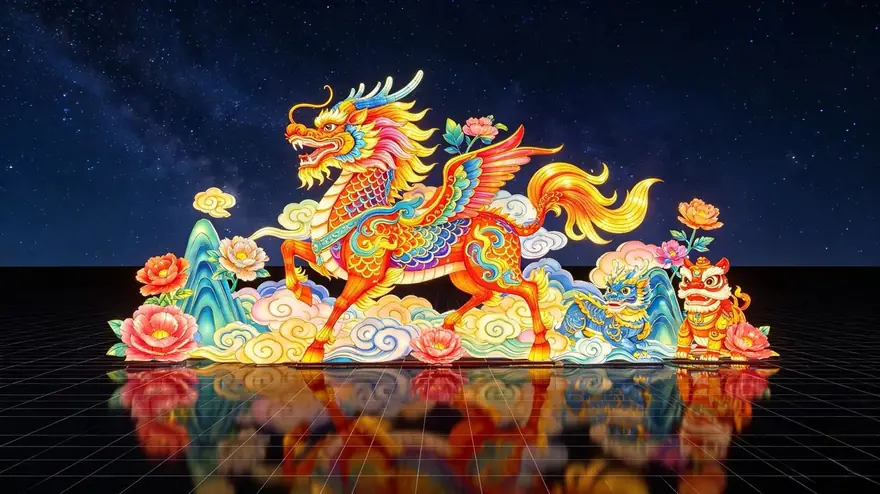
The winged qilin is the anchor of the realm, built as the tallest element so the visitor's eye lands on it before anything else. Around it the scene is kept dark and low, a starry ground plane and a few smaller beasts, so the qilin reads as the one lit creature in a quiet sky. The wings are posed half raised, which gives the silhouette its span without making the piece too wide for a standard pathway, and the body is detailed so it holds interest when a visitor walks right up to it.
Designing the walk-around route
This is a walk-through set, not a single object, so the figures are placed to draw a looping path rather than a front-on view. Visitors enter at one edge, pass the qilin at close range, then circle back through the lower beasts before leaving. The spacing is set so the route never narrows to a bottleneck, and the smaller creatures mark the turns so people do not double back or crowd the centre, which is what keeps a festival queue moving.
Starry light that stays dim
The scene lighting is dimmable and tuned low, with the qilin carrying the brightest zone and the ground plane running as a scattered star field. That contrast is what makes the realm feel like night rather than a lit stage, and it keeps the visitor's pupils open so the detail on the beast reads from a short distance. The whole scene runs within the 200 to 2,000W total, and each zone can be trimmed for the ambient light of the host venue.
Re-assembling a multi-part set
The realm ships as segment-linked frames that bolt together on site, with the qilin in the largest crate and the smaller beasts in shared loads. Re-assembly follows the route plan rather than the crate order, so the central beast goes in first and the perimeter is built around it. Between seasons the silk covers are removed and the steel frames stored flat, ready to be re-dressed in the same starry scheme the next year.