A dragon placed against architecture
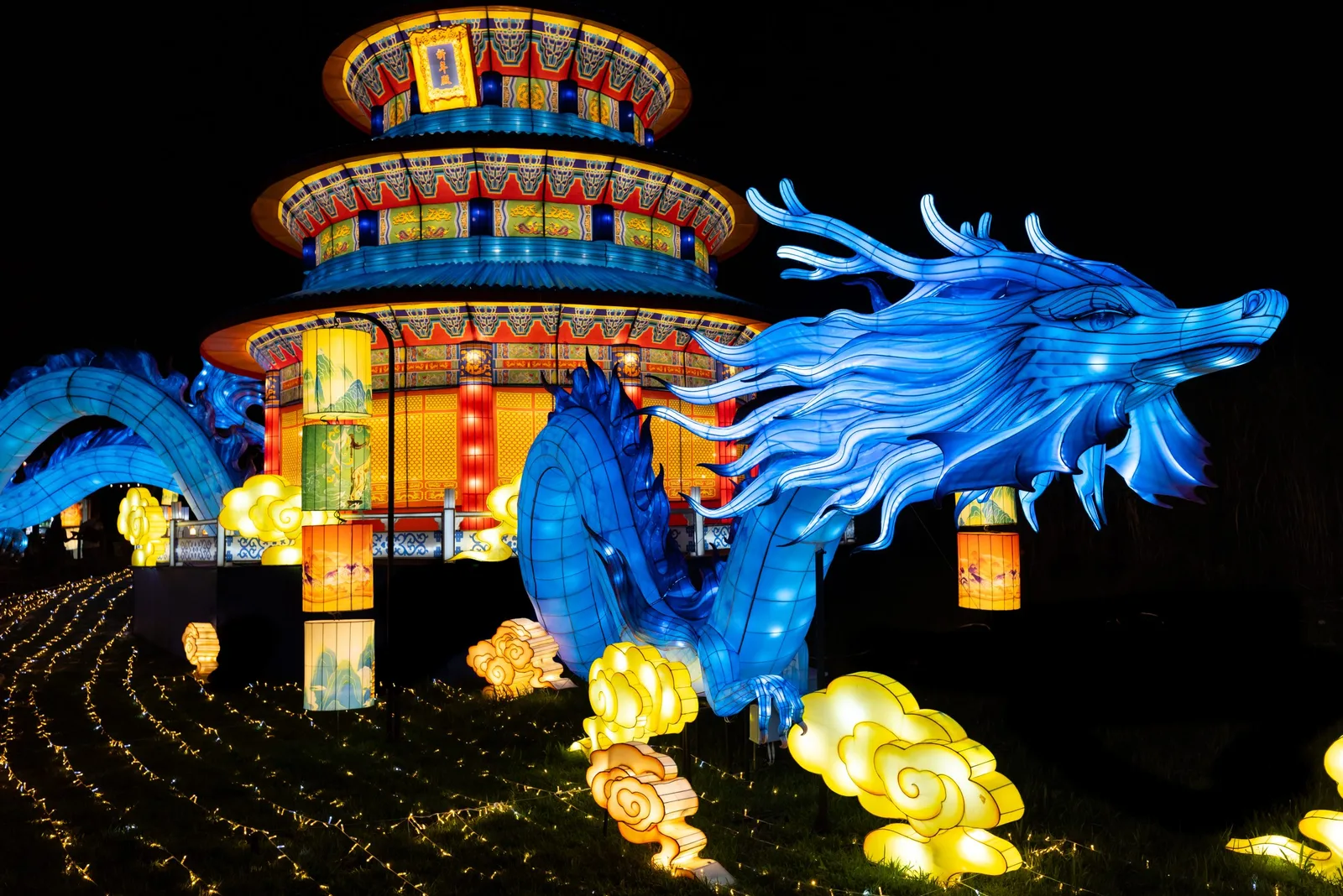
Most cultural centrepieces fail by letting the dragon swallow the building behind it. Here the cobalt dragon is posed coiling past the side of the Temple of Heaven replica, so the building keeps its own vertical reading and the dragon reads as a guardian moving around it. The temple is built as a genuine structure with its tiered roof and circular body, not as a flat cut-out, because a centrepiece visitors walk up to will be seen from every angle and a flat back ruins it. The dragon's tail curls toward the base of the temple while the head rises above the upper tier, drawing the eye upward along the building rather than across it.
Three lighting zones that must not merge
The composition only works if the viewer can separate three things: the cobalt dragon, the warm stone of the temple, and the golden cloud band behind. We run each on its own lighting zone so the dragon can hold deep blue while the temple glows warm cream and the clouds sit in gold. If all three shared one colour the piece collapses into a single blue smudge at distance, which is the usual failure of landmark lanterns. The temple lighting is placed to emphasise the roof eaves and the drum wall, the parts that read as architecture even when the rest is in silhouette.
Why clouds, and why golden
The golden cloud band is not decoration. It fills the empty sky behind the dragon and gives the eye a bright field to read the cobalt body against, the same problem a night sky poses for any dark-coloured figure. Gold was chosen because it sits between the warm temple and the cool dragon and lets both read as separate objects. The clouds are shaped wirework rather than a printed backdrop, so they keep volume when a visitor walks around to the side and the dragon no longer lines up with the temple.
Scale and what the buyer sets
This is a landmark piece, so the temple height and the dragon length are set to your plaza or forecourt rather than to a fixed catalogue size. A temple that has to sit between two retail entrances is built with a narrower footprint than one meant to close off a festival axis. We confirm the viewing distance and the surrounding sightlines in the quotation, because the dragon's coil radius and the temple's roof pitch both depend on how far away the first photograph gets taken from.