A character, not a diagram
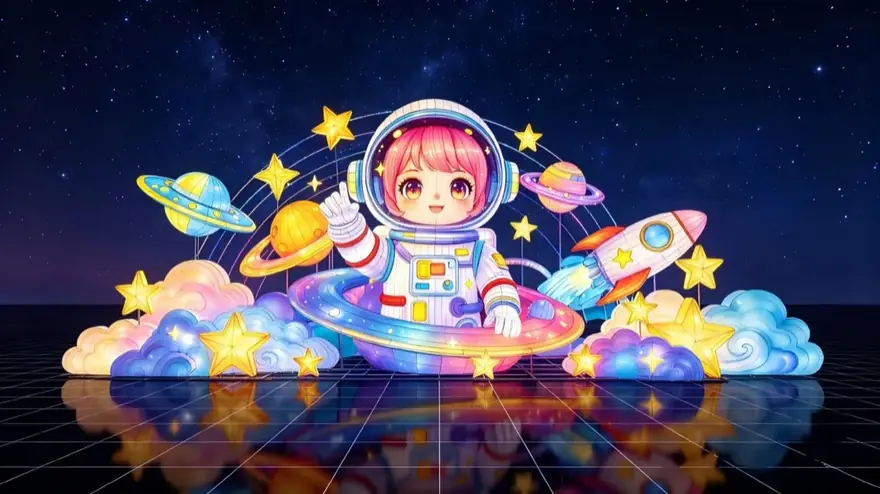
Space-themed pieces usually fail in the same way: they get built as a mascot in a white suit and end up reading as a cartoon. The fix is to build the suit rather than the person. A real pressure suit has a hard torso shell, a domed helmet that sits proud of the shoulders, articulated breaks at the elbows and knees, and a bulky life-support pack. Those are the features that make the figure legible from across a plaza, where the face and hands have already disappeared.
At roughly ten metres the visitor never sees the whole figure at once. They see the helmet first, then the raised arm, then the suit. The build is therefore sequenced around that order: the helmet carries the brightest lighting, the arm creates the diagonal the eye follows, and the body stays quieter so it does not compete.
Three lighting zones
The helmet interior, the suit seams and the star field base each run on their own circuit. That split is what gives the piece depth. A lit visor with a dimmer suit reads as a lit interior behind glass, which is the effect that makes people stop. Suit seams pick out the joint breaks so the silhouette keeps its structure after dark. The base carries a star field pattern that anchors the figure into a floor of light rather than leaving it standing on nothing.
Because the zones are independent, the piece can also be run at a lower brightness late in the evening without going dark, which matters on a long trail where the figure has to stay readable for hours.
Built for a city square
The proportions are set for a public square rather than a stage: broad enough to hold up in photographs with people in the frame, tall enough to be found from across the space, and posed so the raised arm gives every approach direction a distinct view. The suit white is hand-painted with grey shadow zones after the silk is stretched, so the figure still holds its form in daylight with the lighting off.
The base is weighted and braced for a tall narrow figure, which carries more wind load than a wide piece of the same height. Base form, height and the colour temperature of all three zones are confirmed during quoting.
What the buyer sets
Height, pose, base footprint and the lighting split are all fixed before the frame is shaped. Because this is a bespoke build from the XL-CU platform, we work from your site photographs, the surface you can anchor into and your local wind conditions, and supply a structural drawing and 3D render for approval before production starts.