A landmark defined by its lean
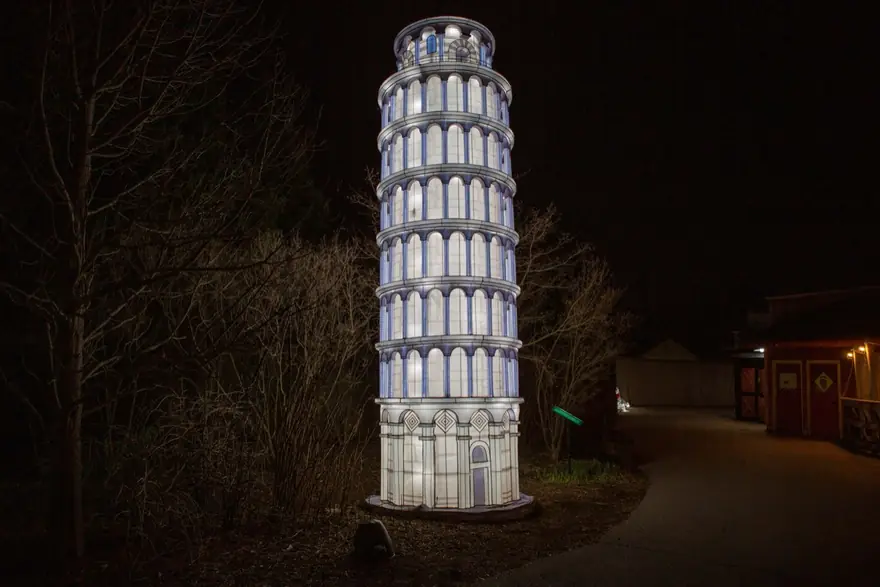
The Leaning Tower of Pisa Lantern works because of the one thing that makes the real building famous: the tilt. As a glowing silk and steel replica it is a photo-magnet for European festival circuits, the kind of recognised form that needs no signage. The engineering problem is also the lean: a vertical tower is simple to anchor, but a leaning one carries its weight off-centre, so the whole structure has to be planned around that offset from the first drawing.
Why the angle is the hard part
The tilt is set to match the real structure's lean, and that single angle drives everything else. The centre of mass shifts toward the low side, so the base plate and anchoring must resist an overturning moment that a straight tower would not have. We build the column in galvanised steel with the lean baked into the frame geometry rather than faked with the cladding, because only the frame can carry the load safely. The silk and acrylic surface is then shaped to follow that true lean.
The view changes with the approach
The piece only reads as the Leaning Tower from the correct side. Approached from the front the lean is obvious and the photograph works; walked around to the side the tilt flattens and it looks like a straight column, which is why placement and the surrounding sightline matter. We advise on the orientation during quotation so the figure faces the main pedestrian flow, and the internal column wash is tuned to keep the lean legible after dark.
Engineering the lean
As a bespoke XL-CU build, the tower is engineered to your site wind zone, with load calculations and fire certificates supplied per shipment. The base is a fixed plate anchored to hardstanding and sized for the lean's overturning moment, and the foundation detail is issued before production. The piece is built in vertical segments for standard road freight and assembled on site, with the lean set during alignment.
Orienting the lean to the flow
The lean only reads from the front, so the buyer must give us the main pedestrian flow before we set the orientation, and we face the figure to that approach. The base plate is anchored to hardstanding and sized for the lean's overturning moment, with the foundation detail issued before production. The tower ships in vertical segments and the lean is set during alignment on site, so the tilt faces the crowd.