A bird placed at the water's edge
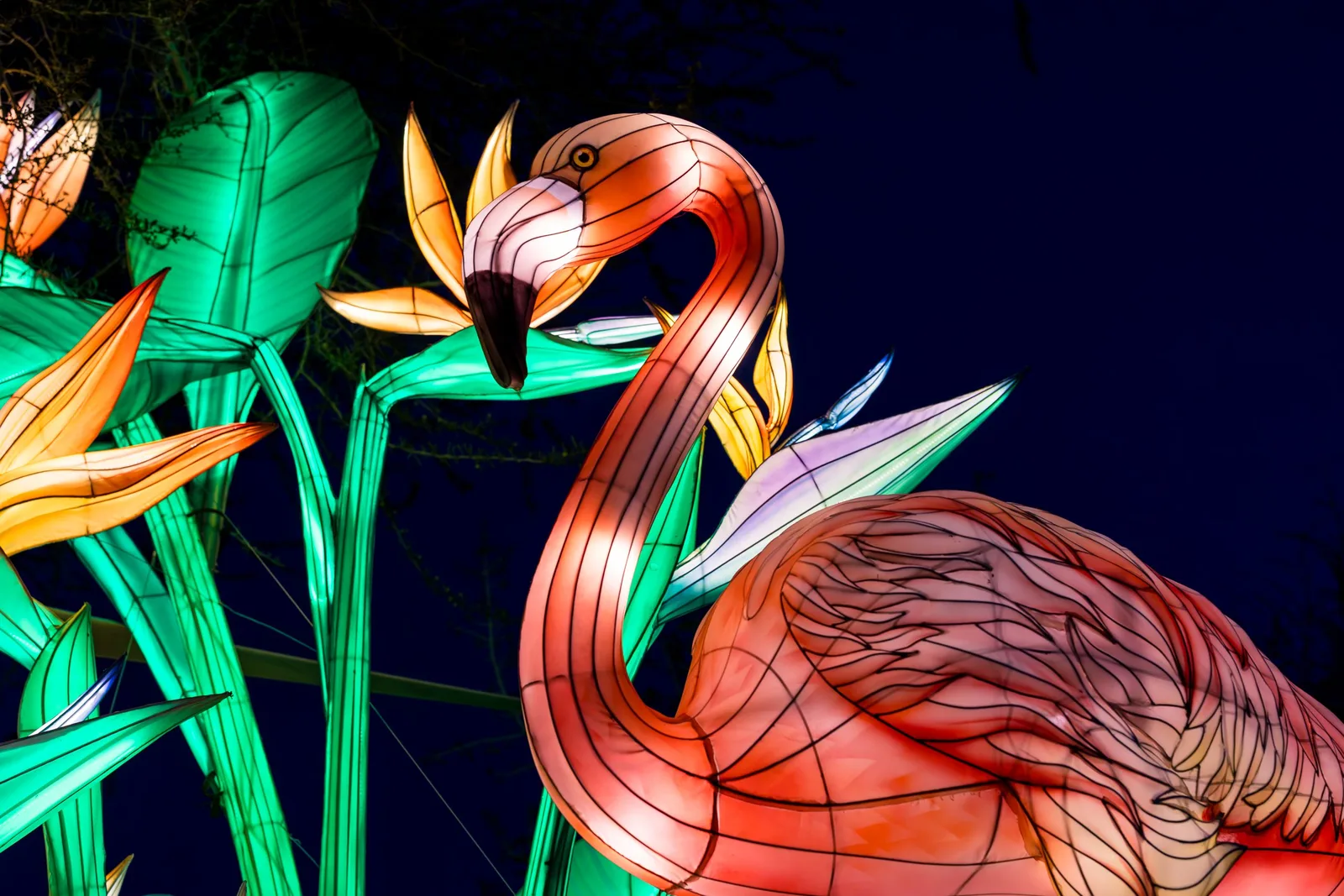
Most zoo and resort trails have a wet edge: a lagoon, a pond, a stream the path follows. That edge is where this piece belongs. The flamingo is modelled in a feeding stance, neck folded down toward the waterline and one leg lifted, so it reads as an animal using the site rather than an object dropped onto it. Visitors walking the trail meet the bird in profile first and only see the full group once they have passed it.
The plumage is the difficult part. A real flamingo is not a single colour; it runs from deep coral at the wing coverts to nearly white at the neck, and light has to pass through that gradient without flattening it into one flat pink. We build the body in layered silk panels, dye each zone separately, then hand-paint the feather breaks so the silhouette still reads as a bird in daylight with the lighting switched off.
The blooms carry the glow
The bird-of-paradise group is lit as its own zone, sitting lower than the bird and running warmer. That gives the composition a bright base under a darker, more sculptural figure, which is also how it works on a real trail. A visitor sees the glow of the flowers from a distance and walks toward it, then notices the flamingo once they are close. On a long walk-through, that sequence is what creates dwell time rather than a single photograph.
Tropical planting without a tropical climate
The blooms are built in the same galvanised steel and silk as the bird, so the group can sit in a Northern European winter garden or a desert resort without any living planting behind it. The flower heads are shaped wirework rather than printed flats, which means the group keeps its volume and shadow when a visitor walks around it. If you want the set to sit inside real foliage, we can supply ground spikes and base plates that disappear into a planted bed.
Colour tuned to the site
The scarlet can be pushed warmer for a sunset trail or cooled toward magenta for a modern resort palette, and the bloom zone can be re-coloured independently. The head, beak and eye detail is always hand-painted after the fabric is stretched, because those three features decide whether the bird looks alert or blank at close range.